
Research process
What a Quantum Portfolio Test on Nine TSX/TSXV Momentum Stocks Showed
By Elnady Market Ideas · Published Oct 5, 2026 · 7 min read
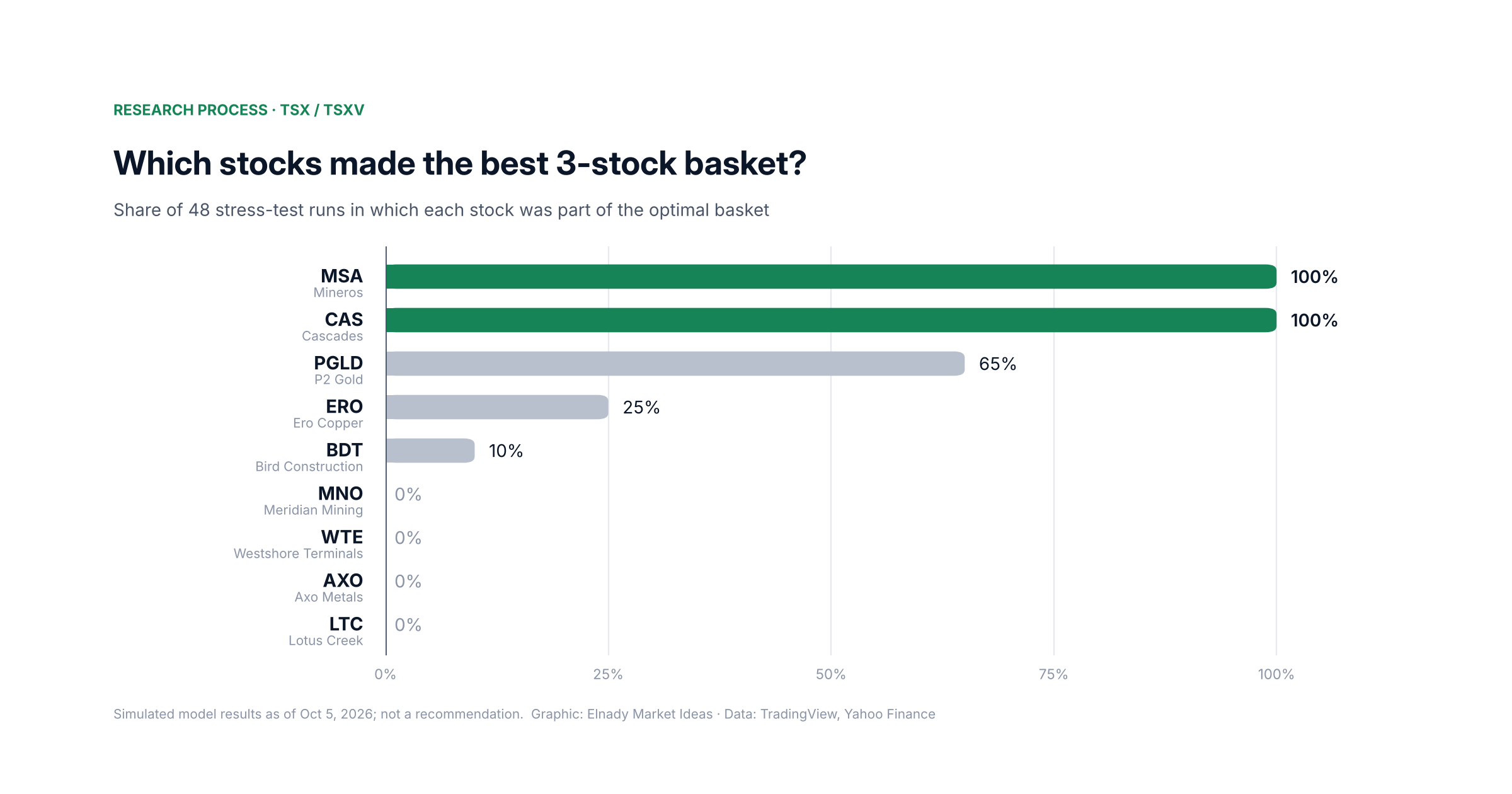
Image: Graphic by Elnady Market Ideas; data from TradingView and Yahoo Finance.
I screened 926 TSX and TSXV stocks, narrowed them to nine momentum names, and tested whether a simulated quantum algorithm could pick a better three-stock swing basket. Mineros (TSX: MSA) and Cascades (TSX: CAS) made the best basket in all 48 stress tests, and the quantum step added nothing an exhaustive check could not do faster.
Why try a quantum approach?
Quantum computing gets a lot of attention in portfolio construction, mostly as a promise. So I tried it on a small, concrete question: from a shortlist of nine TSX and TSXV momentum stocks, which three-stock basket gives the best balance of expected return, risk and trading cost over the next three weeks?
That question fits the format quantum algorithms are built for: a yes/no decision on each stock, with a penalty for risk. And with only nine stocks there are just 512 possible combinations, so every answer the quantum method gives can be checked against the exact best answer. That makes it a fair test.
The short answer: two stocks, Mineros (TSX: MSA) and Cascades (TSX: CAS), made the best basket in all 48 versions of the test. The quantum step itself added nothing that a simple exhaustive check could not do faster.
How the test was run
- Universe: TradingView screener data for all 926 TSX and TSXV stocks on October 5, 2026, around 12:40 p.m. Toronto time.
- Liquidity filter: at least $2 million a day traded on the TSX and $200,000 a day on the TSXV. That left 416 stocks.
- Trend filter: price above the 50-day average, 50-day above the 200-day, and RSI between 45 and 72. That left 99 stocks.
- Shortlist: the 99 were ranked on momentum, trend strength, MACD, RSI, distance to the 52-week high and TradingView's technical rating, with penalties for being stretched far above the 20-day average or reporting earnings within 14 days. The top six TSX names and top three TSXV names went forward: Ero Copper (ERO), Meridian Mining (MNO), Westshore Terminals (WTE), Mineros (MSA), Cascades (CAS), Bird Construction (BDT), P2 Gold (PGLD), Axo Metals (AXO) and Lotus Creek Exploration (LTC).
- Price history: 147 daily returns from March 5 to October 5, 2026, based on adjusted closing prices. The latest prices matched TradingView.
- Expected return: a score built from 20-day momentum (30%), 60-day momentum (25%), ADX trend strength (15%), distance to the 52-week high (10%), RSI regime (10%) and volatility-adjusted momentum (10%). The score was converted into a deliberately modest three-week return estimate, then reduced by an estimate of round-trip trading costs, which are much higher for thinly traded stocks.
- Risk: how the nine stocks moved together day to day, smoothed toward their average correlation to reduce noise.
- Rules: exactly three stocks, equal weight, at most one TSXV name, held about three weeks (15 trading days).
- Solvers: first, an exhaustive check of all 512 combinations, which gives the exact answer. Second, the Quantum Approximate Optimization Algorithm (QAOA), simulated on an ordinary computer as a 9-qubit system, in two versions.
- Stress test: 48 combinations of two scoring models, three assumed levels of forecasting skill, four holding periods (10, 15, 20 and 30 days) and two levels of risk aversion.
What held up
1. Mineros and Cascades: in the best basket 48 times out of 48
- Mineros (MSA): one of the strongest scores in the group: about +16% over 20 trading days, +54% over 60, ADX 40, and only 2.3% below its 52-week high.
- Cascades (CAS): a smoother trend (+56% over 60 days, ADX 42) and, importantly, low correlation with everything else on the list (about 0.2 or less). It lowers the basket's risk. Part of the reason the model likes it is that it is calm, not that its upside is the biggest.
2. The third slot depends on how much risk you accept
- P2 Gold (PGLD): in the best basket in 31 of 48 runs (MSA + CAS + PGLD). It had the highest score, but it trades only about $700,000 a day on the TSXV, and when the assumed forecasting skill is low, trading costs eat most of its advantage.
- Ero Copper (ERO): in the best basket in 12 of 48 runs, and in 43 of 48 when TSXV names were excluded entirely (MSA + CAS + ERO).
- Bird Construction (BDT): in the best basket in 5 of 48 runs, only at the more cautious settings.
What dropped out, and why
- Bird Construction (BDT): up about 20% over 20 days, but only 25% over 60 days. Against this group, that reads as a recent jump rather than a sustained trend.
- Meridian Mining (MNO): decent momentum, but it moves closely with ERO and MSA (correlation about 0.5), so it adds little diversification, and its trading cost is higher.
- Axo Metals (AXO): strong momentum, but it is one of the most thinly traded names on the list. The cost estimate wiped out most of its expected edge.
- Westshore Terminals (WTE) and Lotus Creek (LTC): the weakest momentum scores of the nine.
Did the quantum part help?
No.
- Standard QAOA (with a penalty for picking the wrong number of stocks) found the true best basket only about 0.9% of the time. It mostly learned to pick three stocks, not the best three.
- A constraint-preserving version (starting from an equal mix of all valid three-stock baskets and only swapping one stock for another) did much better: it stayed inside valid baskets 99% of the time and found the true best basket 14 to 43 times more often than random guessing. But at the main settings, its most likely answer was MSA + CAS + ERO, not the true best, MSA + CAS + PGLD.
- The exhaustive check of all 512 combinations took well under a second and is always exact.
At this size, a quantum algorithm is a demonstration, not an edge. The useful part of the exercise was the framework around it: a return estimate, a risk measure, trading costs and clear rules.
The numbers that matter more than the method
- The expected edge is small. For the top baskets, the model's net expected return was about 0.2% to 0.4% over three weeks. Their typical three-week swing was about 9% to 10%. Noise dominates, so position size and a planned exit matter far more than which of the top baskets you pick.
- Five of the nine are miners that move together. ERO, MNO, MSA, PGLD and AXO had daily correlations of about 0.34 to 0.56. A basket of them is mostly one bet on metal prices.
What this does not mean
- It is not a forecast. The scoring weights and the assumed forecasting skill are assumptions, not values proven on unseen data.
- The sample is short. 147 trading days is not much history, and correlation estimates from it are noisy.
- The list was already filtered for winners. Starting from nine stocks that had already run up builds in selection bias.
- It is a snapshot. Results reflect prices as of October 5, 2026. Upcoming earnings dates per TradingView's calendar: ERO on November 2, CAS on November 5, PGLD on November 10 and MSA on November 17.
- Each company carries its own risks. MSA depends heavily on the gold price after a strong run, and has a buyback program in place for up to 5% of its shares. CAS returned to profit in the second quarter on a packaging recovery. PGLD is a small TSXV gold company whose value depends heavily on project results and access to financing. ERO's trend is the least established of the four (ADX 19).
A model like this is a way to organize a decision, not to make it.
My ideas. Your decisions.
Disclosure
This article is general market commentary and education, not personalized investment advice, and it is not a recommendation to buy or sell any security named. Model results are simulated, depend on assumptions, do not predict future performance and can differ materially from real trading. At the time of writing, the author holds no shares, options or other financial interest in Mineros (TSX: MSA), Cascades (TSX: CAS), P2 Gold (TSXV: PGLD), Ero Copper (TSX: ERO), Meridian Mining (TSX: MNO), Bird Construction (TSX: BDT), Westshore Terminals (TSX: WTE), Axo Metals (TSXV: AXO) or Lotus Creek Exploration (TSXV: LTC). Use your own analysis and make and monitor your own decisions.
Sources
- TradingView: Canadian stock screener data for TSX and TSXV, and earnings calendar (October 5, 2026).
- Yahoo Finance: daily adjusted closing prices, March 5 to October 5, 2026.
- Farhi, Goldstone and Gutmann (2014), A Quantum Approximate Optimization Algorithm.
- Hadfield et al. (2019), From the Quantum Approximate Optimization Algorithm to a Quantum Alternating Operator Ansatz.
- Grinold and Kahn, Active Portfolio Management: converting a score into an expected return.
- Mineros S.A., Normal Course Issuer Bid (July 14, 2026).
- Cascades Inc., Results for the Second Quarter of 2026.
- Ero Copper, Third Quarter 2026 results date.
- P2 Gold, Car Body Zone and Gabbs project update.
- Chart: graphic by Elnady Market Ideas; screener data from TradingView (tradingview.com).
General commentary. Make and monitor your own decisions. Read the Terms before using this service.