
Research process
Before You Buy: Five Checks for a Canadian Day-Trade Setup
By Elnady Market Ideas · Published Sep 29, 2026 · 5 min read
Updated
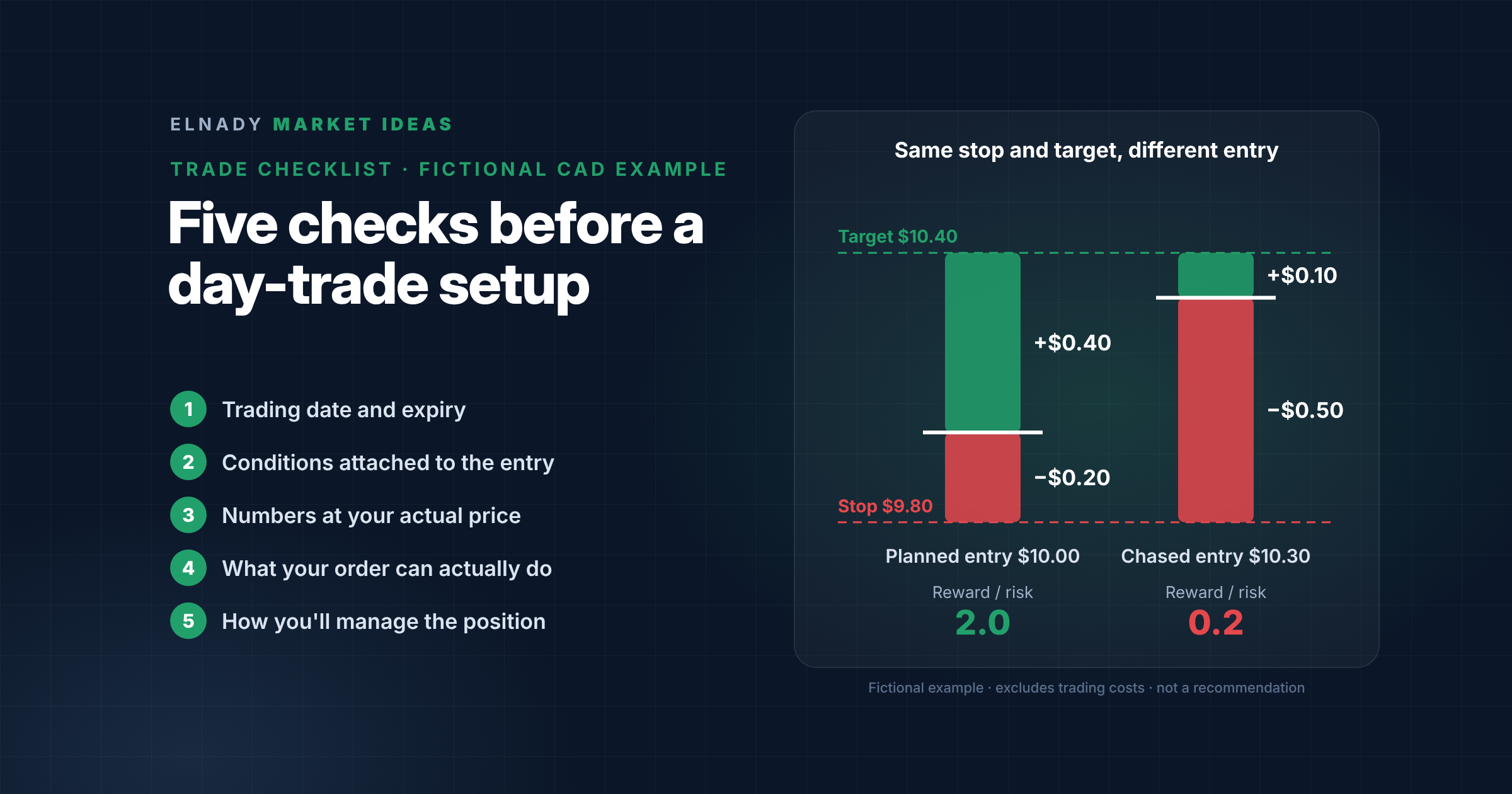
Image: Graphic by Elnady Market Ideas; fictional example from this article.
Learn how to check a trade idea’s timing, entry conditions, potential gain, planned loss and order instructions before making your own decision. A fictional CAD example shows how chasing a price changes the trade.
A morning trade idea can look straightforward: a stock, an entry price, a stop and a target. The difficult part is deciding whether that idea still applies when you are ready to place an order.
A price can reach the entry area while other conditions have already failed. It can also move so far beyond the entry that the potential gain and planned loss are very different from the original example.
Before considering a Canadian day-trade setup, work through these five checks. The numerical example below is fictional, uses Canadian dollars and does not refer to an actual company.
1. Check the trading date and expiry
Start with the publication time, applicable trading date and stated expiry. An email arriving late does not reset the clock on the idea.
Check whether the entry window is still open and whether any stated invalidation condition has occurred. Invalidation means a condition that makes the original setup no longer applicable. It might be a specified price movement, a change in the supporting information or the end of the permitted entry window.
For Elnady Market Ideas, an unused daily setup does not automatically carry over to the next trading day. Check the setup's separate instructions for managing any position already entered; cancelling an unfilled order does not close an existing position.
2. Read the conditions attached to the entry
An entry range describes where a trade might be considered. The accompanying conditions explain what else must happen first.
A setup could require a particular start time, confirmation above a defined level or a stated limit on the bid/ask spread. A stock trading inside the entry range does not, by itself, establish that those conditions have been met.
For example, if an idea requires waiting until 9:45 a.m., seeing its entry price at 9:32 a.m. does not satisfy that instruction. If the invalidation level has already been breached, a later return to the entry area does not automatically reactivate the idea.
If you cannot explain what qualifies the entry and what invalidates it, you do not yet have a clear basis for evaluating that setup.
3. Recalculate the numbers at your possible entry price
Consider this fictional long trade, where shares are bought first and sold later:
- Intended entry: $10.00
- Planned stop level: $9.80
- Illustrative target: $10.40
At the intended entry, the distance to the stop is $0.20 per share and the distance to the target is $0.40. The potential reward is twice the planned price risk: $0.40 divided by $0.20 equals 2.
Now imagine buying at $10.30, while keeping the same stop and target:
- Distance to the stop: $10.30 minus $9.80 = $0.50 per share
- Distance to the target: $10.40 minus $10.30 = $0.10 per share
- Potential reward divided by planned price risk: $0.10 divided by $0.50 = 0.2
For the same hypothetical 500 shares, the planned loss at the stop changes from $100 to $250, while the potential gain at the target falls from $200 to $50.
These calculations assume fills exactly at the stated prices and exclude trading costs. They are not maximum/loss guarantees, return forecasts or suggested position sizes. A ratio of 2 does not establish that a trade is profitable; the likelihood of different outcomes matters too.
The later entry changes the proposition. Follow the setup's missed entry instructions instead of treating a higher purchase price as a minor adjustment. Moving the target farther away would require fresh reasoning; it would not make that target more likely to be reached.
4. Understand what your order can actually do
The last traded price is a record of a transaction. It is not a promise that your order will receive the same price. Check the current bid and ask, the spread between them and the available trading interest. A larger spread can materially affect a small intended gain.
Order instructions also matter:
- A market order seeks execution against available prices. Its final price can differ from the quote you saw.
- A limit order sets the highest purchase price or lowest sale price you will accept. It may fill partially or remain unfilled.
- A stop-market order, where your broker supports it, becomes a market order after its trigger. The stop price is not a guaranteed exit price.
- A stop-limit order adds an execution-price limit after the trigger. If the market moves beyond that limit, the order may remain unfilled while the loss grows.
CIRO's guidance warns about unexpected execution prices for stop orders without reasonable price limits. Its order type guidance also explains the non-execution risk of stop-limit orders. Check your broker's own trigger rules and available order types before relying on them.
5. Decide how you will manage the position
Before entering, be able to describe your position size, planned exit, reasons to abandon the idea and response if the stock moves through your intended exit level. A written loss estimate helps you understand the plan, but it cannot prevent a larger actual loss.
Also consider whether you can monitor the position and your orders. Waiting for another email is not an exit management method. Declining a setup is a valid decision when its conditions, execution risks or monitoring requirements do not fit your circumstances.
Elnady Market Ideas does not provide routine intraday updates. Material errors may result in a correction or withdrawal. The operator may or may not trade a published setup, and any personal trades may differ in timing, price and exit. Subscribers must make and monitor their own decisions.
Sources and further reading
- Ontario Securities Commission's GetSmarterAboutMoney: How to buy and sell stocks
- GetSmarterAboutMoney glossary: bid, ask and bid-ask spread
- CIRO: Guidance Respecting the Management of Stop Loss Orders, August 19, 2025
- CIRO: Guidance Respecting the Use of Certain Order Types, historical guidance on execution risks
Sources reviewed September 29, 2026. The fictional calculations and explanatory examples are provided by Elnady Market Ideas. Links are educational references and do not imply regulatory approval or endorsement.
This article provides general education, not individualized investment advice or a recommendation to trade a particular security. Trading can result in the loss of all money invested. Entry levels, stops and targets do not guarantee execution or limit actual losses. Consider your circumstances and consult a qualified, registered professional if you need personal investment advice. Read the Terms of Service before using the subscription service.
General commentary. Make and monitor your own decisions. Read the Terms before using this service.